The Income Factory Review
A review of the The Income Factory by Steven Bavaria
Picking this book
Similar to my previous book review on The Millionaire Next Door we were once again heading back down south for some warmth and sun. So I picked up this book on my Kindle to read on the beach and started Zelda the Echoes of Wisdom for my switch. Yes this was our third trip in less than 4 months however this one was a large group trip in which the flight and all inclusive trip was $2550 per couple. Shout out to my friend who found this deal back in the summer. I have definitely found traveling especially on a budget is all about timing. I won’t be doing a post for this trip as aside from the $2550 we only did one golf excursion and kept all other spending to a minimum. Total cost was just over $3000 CAD.
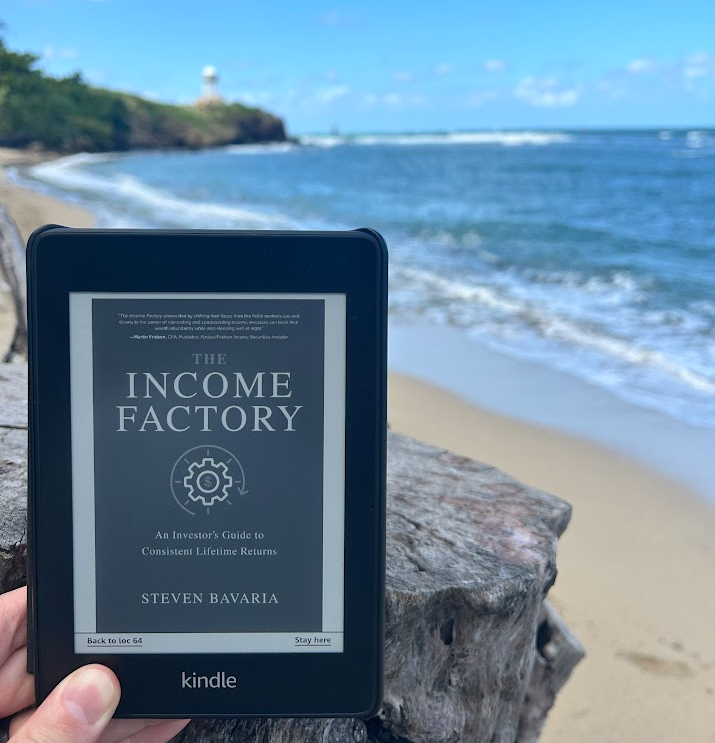
Enough about the trip and back to the book. Why did I pick this book firstly because it has been talked about in the financial groups that I am a part of and somewhat recently Adriano over at Passive Income Investing interviewed the author Steven Bavaria. After watching that I knew I wanted to dig in and find out more.
My Thoughts
The book starts off by giving some background and walks through how everyone is conditioned to focus so much on stock price appreciation. There are many traditional news stations that will give you stock market information practically 24 hours a day 7 days a week. Steven wonders if there was a better way and looks into alternative investments and landed on the income factory approach targeting 10% annual distributions achieving the doubling ever 7.2 years as per the rule of 72.
- incase of the rule of 72 is new to you it is fairly simple. You take 72 and divide it by your average return the result is an approximation in years as to how long it will take your investment to double
- note this can be distributions, price appreciation or a combination of both
Unlike the Millionaire next door this book mostly reads like a textbook which definitely makes it harder to get through but I believe there is a lot of good content in there. In fact the first chapter of the book is entitled “How to Use This Book”. The author calls out the book is essentially 3 in 1. Where the first book is about the philosophy of the income strategy, the second talks about potential investments and the third discusses risk vs reward.
The first book I found pretty interesting and overall it was pretty solid although there was a fair amount of repetition. The 5th chapter is all about determining what sort of income factory is right for you. I really enjoyed this chapter as it parallels my line of thinking over the last couple of years. That line of thinking is do I want to stick with stock price appreciation (or dividend growth), go all in on high yield passive income or do both. Income Factory Light is the term that the author uses for doing both so I guess my portfolio is an income factory light with an average yield of 6.5%. I do have stock price appreciation so I am getting my over 10%. However what happens if the market trades sideways for a few years? Well I would be under that 10%, but, thinking long term as I am still in my 30s it should average out about the 10%.
The chapter then moves on to psychology which we have talked about on this blog before. The pure stock price appreciation approach is not for the faint of heart and if you are going to panic sell when the markets drop you will significantly affect your long term progress. It then proceeds to talk about the different types of risk, complexity (aka not understanding the investment), liquidity (such as in closed end funds) and credit risk. The chapter concludes talking about taxes and compares account types strategies and overall yields (which the book refers to as blended yields).
I did not take the advice to stop after chapter 5 (end of the first book) and continued into the second book with chapter 6. Chapter 6 building the portfolio had a lot of information and introduced a ton of investment types that I have never heard of so I did enjoy that. However, we have gotten so many diversified ETFs over the last 5 years I don’t think you need to reach past those. Chapter 7 the author lays out a few model portfolios which I think is fine as long as you somewhat ignore the ticker symbols. As I mentioned previously we have so many new products there are likely new ones that are better now and if I recall correctly the author states something along those lines or at least says please do not copy these!
At the beginning of chapter 8 the author once again states many investors may decide to stop reading the book there and honestly I probably could have. However I was on vacation and many members of the group would read on the beach each morning so I had the perfect excuse to soldier on. The remaining chapters talk about how to really push the income factory to the higher yields. It breaks down how to think about risk and talks about corporate structure. One example I remember reading about is bonds. Now this is from memory but it essentially said each bond rating level downwards is essentially 4 times as likely to default and the increased yield is definitely not 4 times as much. Near the top aka AAA down to A or maybe BBB is still realtively safe. 4 times nearly zero is still pretty close to zero. However at a certain point it becomes 10 times as likely to default between levels.
Before I dive to far down the rabbit hole I want to point out while this was somewhat interesting to me I had to read it in small chunks to get through it and now we have many modestly leveraged ETFs that we can choose from to push or yields. Such as:
- HDIV
- HYLD
- BANK
- QQCL
All in all I think the first half of the book is worth a read especially if you are relatively new to the this space. It definitely gives some great background information. Even if you read the first 1/3 like the author suggests you will learn a lot.
That’s all for this week folks, thanks for stopping by!
You can support me by:
- Subscribing to my YouTube Channel
- Using my WealthSimple referral link
- Simply continuing to read my weekly posts here!
Cheers ☕